
Review: The Ghost of ‘Mother Mary’
Is David Lowrey really the right person to lecture us on fame and female friendships?
Isabella Bernstein
04.24.2026
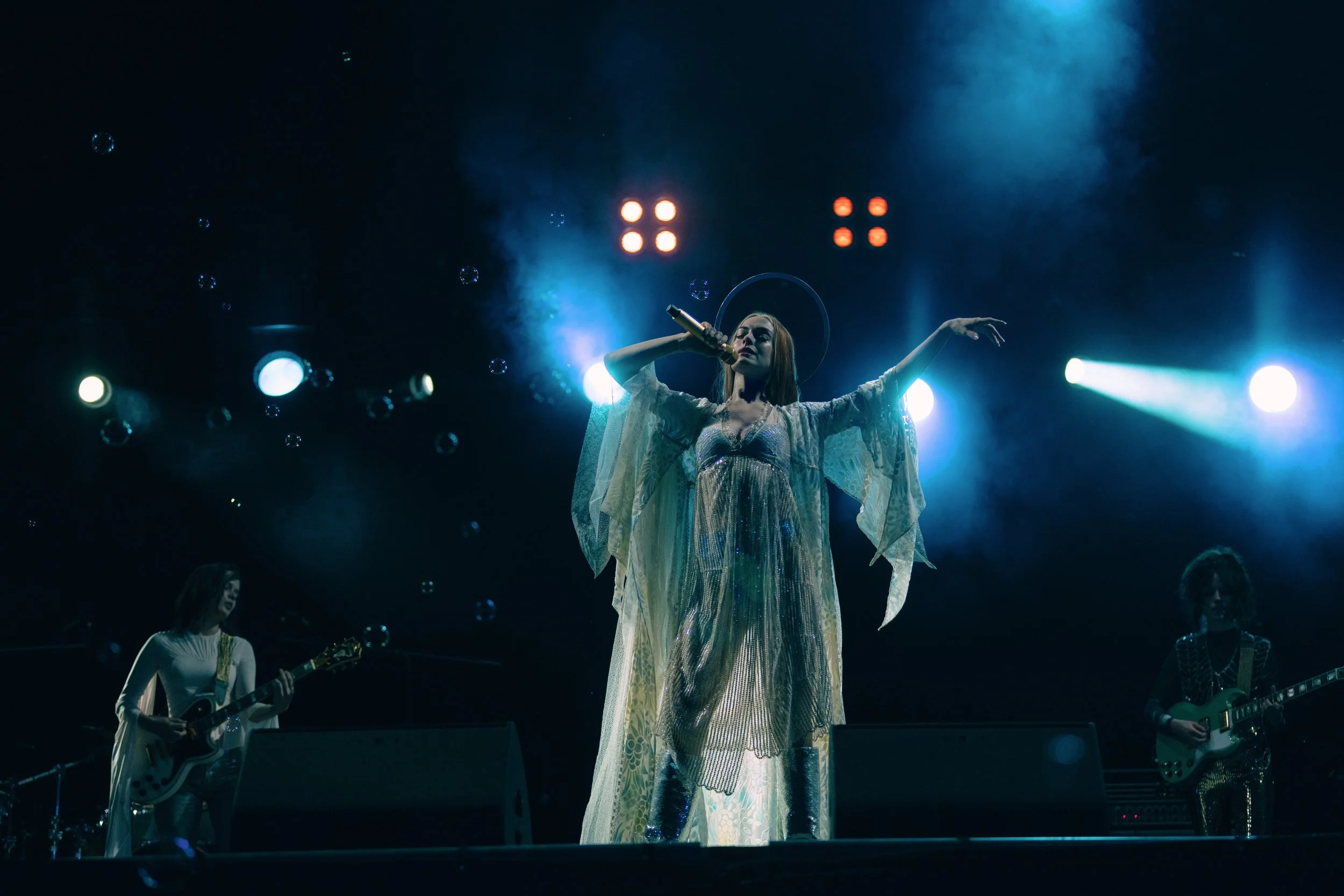
Credits: A24
*This review contains minor spoilers*
It seems A24 has found its new niche. Last year, it was the impossible love triangle with “Materialists” and “Eternity”; the year before it was early aughts‐inspired horror with “Y2K” and “I Saw the TV Glow.” But this year’s is more specific: films that critique pop stardom — moreover, films with Charli XCX that are loosely inspired by Taylor Swift’s particular brand of pop stardom.
February saw the release of “The Moment,” a mockumentary by and about a semi-fictional XCX taking on an alternate version of her “BRAT” tour, which garnered mixed feelings from older critics and rave reviews from younger folks who had been slime green clad since 2024. Now, on a reused silver platter, A24 presents “Mother Mary.”
Written, directed and produced by David Lowery with music from XCX, Jack Antonoff and FKA twigs, “Mother Mary” follows Anne Hathaway in the titular role as a Lady Gaga-ian pop star who flees to her estranged best friend and costume designer Sam’s (Michaela Coel) remote atelier. Mother Mary, known only by her stage name, is revealed to be an intruder in the House of Usher-style mansion the moment that Sam sees her at the helm of her assistant, Hilda (played by an underutilized Hunter Schaffer). Her aim is simple: she needs a dress that is “just me, all of me,” she tells Sam, for her comeback show after a mysterious accident cast her out of the spotlight. And, of course, Sam is the only person who knows her well enough to make it.
Sam agrees to make the dress under two conditions: that Mary apologizes to her three times for abandoning her as a stylist and friend, and that she cannot object to anything Sam wants to design for her. Mary is at the whim of Sam for the first time in her life — it seems, it is the first time she has been at the whim of anyone but herself — a tension that Lowery balances the entire film on.
“Mother Mary” is a theater-like two-hander that explores Mary and Sam’s relationship to their varying degrees of fame, as well as to their art and to one another through heavy dialogue and short flashbacks. Lowery spends the first act of the film attempting to lay out not only the basis of the women’s relationship, but also how it evolved to the tense yet inseparable bond viewers find them in. After working together since the beginning of her career, Mary abandoned Sam because she “needed a change” (which is ironically the exact reason she runs back to her), and with her, took credit for much of Sam’s creative direction. Sam is sarcastic, biting, even mean at times toward a brittle Mary, deservingly so, but the two warm up to one another once they share the revelation that, since their split, they are both connected by supernatural visions of a crimson chiffon ghost.
Coel and Hathaway’s chemistry morphs into something frighteningly compelling — one built on closed-off body language, lingering touches and soft whispers — but this connection is found less in Lowery’s script and more in the interaction of Coel’s smooth iciness and Hathaway’s perpetual dampness. Their physicality with one another suggests their relationship bordered on sapphic, but their dialogue doesn’t ever outright explain their dynamic nor give enough away for the audience to come to a meaningful conclusion about it.
What the film does not address becomes its weak points: In a conversation about how fame can overwhelm and devour a person, we know very little about who Mary is outside of the atelier and her performances, as mesmerizing as these flashbacks may be. She tells Sam she has trouble sleeping and eating, and that’s about it. Lowery would have done well inserting pretext to Mary and padding her with more than tears, shaky pleas and halo headpieces. This is where “Mother Mary” fails and “The Moment” succeeds: XCX blends situational humor with anxiety-inducing dialogue and cinematography to accurately show the whirlwind that surrounds pop stars at every waking moment, and while “Mother Mary” inserts a few dry laughs and shows Mary stumbling on and off stage, it comes nowhere close to the personal exhibit of arrogance and stress that XCX was able to conjure up. “The Moment” is compelling because it is from the performers mouth (as XCX also co-wrote and produced the film), a stature that Lowery, to no fault of his own, does not have, which leaves the “Mother Mary” feeling voyeuristic instead of experiential.
Mary and Sam’s relationship parallels XCX and her creative director, Celeste’s, in its closeness and will-they-won’t-they absolution, but Lowery’s script, for all its pretension and heavy-handed supernatural metaphors (“These metaphors are exhausting,” Mary even tells Sam), is lacking the relatability and natural conversational flow that makes “The Moment” an apt allegory for reality. It begs the question: is Lowery, a man, really the right person to lecture audiences on the complexity of female relationships?
While their estrangement is the crux of their conflict and haunting, “Mother Mary” leaves out other crucial industry powers that might have made Lowery’s critique of modern Western fame feel more complete. The film takes a race blind look at a powerful white woman taking credit for a Black woman’s design, inspiration and even memories, as Sam tells Mary that one of her most famous looks, of which Mary took credit for in a Vogue article, was based on Sam’s first communion. The film ignores larger, systemic issues that it should be apt to explore in favor of focusing on personal vendettas and fame fatigue.
“Mother Mary”’s marketing made it clear: the film is “not a ghost story,” nor is it a “love story.” In reality, “Mother Mary” is not much of anything. The movie itself is a ghost of a story about friendship, love and fame — beautiful, fleeting and, ultimately, hollow.
*A revision has been made to correct a misspelling of Mr. Lowery’s surname. The Avenue regrets this error.
